
What tai chi is, in one paragraph
Tai chi is a slow, flowing practice that comes from Chinese martial arts. The moves are soft and continuous, and they follow the breath. Most beginners learn short forms built from the Yang style, such as the simplified 24-form, and many also learn Baduanjin, a set of eight standing qigong moves. You do not need to learn a whole form to start. One move at a time is how most teachers begin too.
A beginner plan for your first week
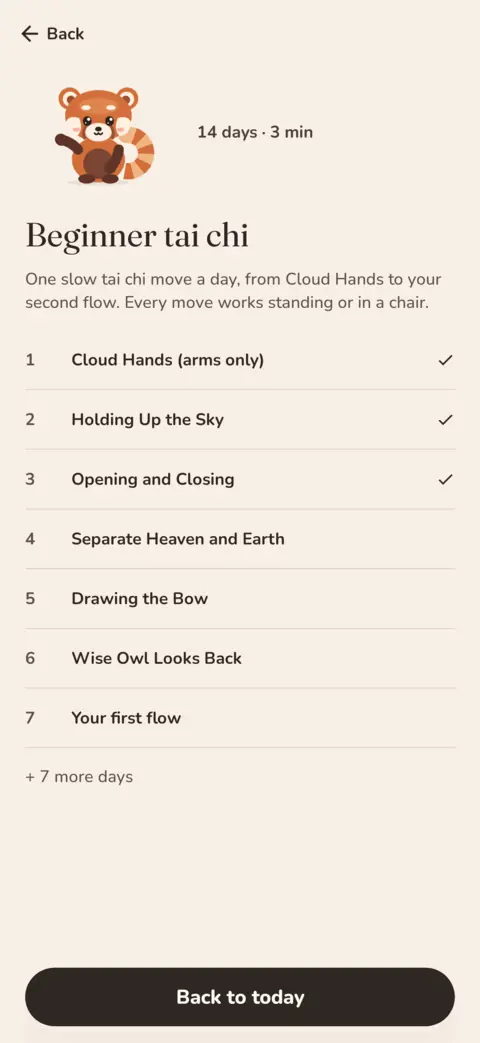
This is the order Zenbo's Beginner tai chi program uses. Each move is practised for about a minute and a half, inside a 3-minute session.
- Day 1, Cloud Hands (arms only). Hands drift side to side in front of you while the waist turns gently. Read the steps in Cloud Hands for beginners.
- Day 2, Holding Up the Sky. Hands rise on the in-breath and lower on the out-breath.
- Day 3, Opening and Closing. A small opening and closing of the arms that starts and ends every later session.
- Day 4, Separate Heaven and Earth. One hand rises while the other presses down, then swap.
- Day 5, Drawing the Bow. A shallow stance with a slow bow-drawing arm, with a chair version.
- Day 6, Wise Owl Looks Back. A small, easy turn of the head and shoulders, never forced.
- Day 7, your first flow. The week's moves joined into one short sequence.
Standing or in a chair
Both count. Standing adds weight shifting and balance practice. Seated tai chi keeps the same arm paths and breathing and suits stiff mornings, desk breaks and anyone who prefers to sit. See chair tai chi for how the moves change when you sit.
How much is enough at the start?
A few minutes a day is a reasonable beginning, and you can add time when it feels good. Short and regular beats long and rare for building a habit. More on this in how much tai chi a day.
Common beginner mistakes
- Rushing. Slow is the point. If you run out of breath, slow down.
- Locked knees. Keep them soft, a little bent.
- Forcing range. Small movements are fine. Move only as far as feels easy.
- Learning too much at once. One new move a day is plenty.
Zenbo is gentle movement for calm, not medical advice. If you have an injury, a health condition, balance problems or are pregnant, check with your doctor first. Move within your comfort, use the chair version if you like, and stop if something hurts.
Questions
What is the easiest tai chi move for beginners?
Cloud Hands with the arms only is a common first move: the hands drift side to side at chest height while the waist turns a little. It is slow and symmetric, and it works standing or seated.
Can I learn tai chi at home without a teacher?
You can start at home with short guided sessions. A local class adds a teacher who can watch your form, which many people enjoy later. Zenbo is a gentle daily start, not a replacement for a class.
Can I do it sitting down?
Yes. Every move in Zenbo has a chair version, and you choose standing or chair once in the app. You can change it any time under Practice.
Is Zenbo free?
The daily 3-minute session is free, every day, with no trial needed. Premium adds the 10 and 20 minute flows, both 14-day programs and two extra scroll colours. In the US it is $34.99 a year with a 7-day free trial for new customers, $8.99 a month, or $79.99 once for lifetime. Prices vary by country and the store shows yours before you pay.